Your complete guide to starting a clothing business in Dubai 2026: From setup to success
Your complete guide to starting a clothing business in Dubai 2026: From setup to success
Explore market insights, licensing steps, and branding tips to establish your fashion venture in Dubai’s dynamic retail landscape
Vincy Amirtharaj
58 post
Senior Business Setup Consultant, Dubai
Dubai is known to be the fashion capital of the Middle East with a combination of import-driven luxury market, homegrown brands and a friendly population in terms of the new fashion. This successful fashion and retail hub hosts all kinds of fashion brand concepts, including high-end boutique in City Walk, a sustainable slow fashion label or a niche online clothing store. With the UAE apparel market projected to surge in 2025, many local entrepreneurs are moving quickly to capitalize on Dubai’s large and diverse consumer base. This includes affluent shoppers purchasing luxury items as well as Gen Z consumers seeking trendy streetwear and modest fashion.
The legal environment of trade in the UAE has become easier to navigate due to newly amended laws that permit 100% foreign ownership of mainland commercial trade licences. There are two options available to designers who wish to launch their brands. They may either establish a retail outlet to attract foot traffic and build visibility or setting up a creative base within a specialized free zone such as the Dubai Design District (d3). Choosing the correct type of licence is critical. The differences between a garment trading licence and a fashion design consultancy licence will determine your ability to import fabrics, work with local tailors and sell products online through your own e-commerce platform.
Having a well-defined and viable operational strategy beyond an excellent design guarantees your retail success in this highly competitive marketplace. In terms of fashion, Dubai is entering into conscious fashion so it is quite essential to source high-quality textiles. Apart from right sourcing of materials, you may need to get Dubai Municipality approvals for shop fit-outs to ensure compliance with the Dubai Building Code.
This guide breaks down the key costs of starting a clothing business in Dubai, the timeline for securing your investor visa and the regulatory requirements you must comply with. Ensuring compliance with import-export codes is a step close to building a strong operational foundation for your business. By implementing your business model in accordance with Dubai's vision for digital innovation and retail excellence, you are positioning your brand for long-term success in a highly profitable market.
Typical 8-week setup timeline
Week
Authority / Task
Key output
1
DET or Free Zone
Initial approval ✓ | Trade Name Reservation Certificate ✓
Promotional Permit (optional), Shop Insurance - Grand Opening!
Note: E-commerce licenses (without physical shops) can compress Weeks 1-4 into 5-7 days; physical shop fit-outs may extend Week 3-5 depending on contractor speed.
"Dubai has established itself as a global capital for the fashion and retail economy, offering a platform for international brands and local designers to thrive."
- Industry Insight
Select the DET / free-zone activity that matches your brand model:
Ready-to-wear Garments
General trading of men's, women's, and children's wear.
High-end / Luxury Boutique
Premium retail in malls or locations like City Walk.
Textile Trading
Importing and selling raw fabrics to tailors and designers.
Fashion Design Service
Professional service license for sketching, pattern making, and consulting.
Tailoring & Embroidery
Custom-made garments, alterations, and uniforms.
Abaya & Modest Fashion
Specialized manufacturing and retail for the GCC market.
Online Fashion Retail
Selling clothes exclusively via website or Instagram (requires E-trader or E-com license).
Pro tip
Clarify if you want to manufacture (tailoring license) or just sell (trading license). If you want to do both, you may need a mixed license or separate units.
Step 2: Choose a trade name
Pick a unique name that reflects your brand identity. It must be reserved with DET (Mainland) or the Free Zone. For fashion, ensure the name isn't trademarked by global brands to avoid IP disputes. This step ensures that your brand complies with local naming conventions mandated for company formation in Dubai.
Quick Fact
Dubai Mall alone welcomed a record 105 million visitors in 2023, making it the most visited place on Earth. A prime location for fashion visibility.
Source: Dubai Media Office
Step 3: Draft a fashion business plan
Sourcing & Manufacturing
Fabric suppliers (China, Italy, India) or local workshops.
Collection Strategy
Seasonal drops (SS/FW) vs. fast-fashion or made-to-measure.
Sales Channels
Brick-and-mortar boutique, Instagram shop, or marketplaces (Namshi/Noon).
Pro tip
Allocating budget for shop fit-out (interior decor) and initial stock is critical. Banks often require 6-months of operational runway in your plan.
Cost snapshot · 2025
Sponsorship: Not required (100% Ownership)
DED initial approval: ~AED 120
Trade-name reservation: AED 620
Mainland Trading Licence fee: AED 12 000 - 18 000
E-commerce (E-Trader) License: from AED 1 070 (Home-based)
Shop Fit-out Permit: Varies by sq.ft (approx AED 2000+)
Shop Insurance: from AED 3000 / year
*Costs vary based on shop size (Ejari value) and location (Mall vs Street).
Setup-cost estimator (AED)
Estimated setup cost: —
Get detailed breakdown on WhatsApp
*Includes AED 740 for initial approval (120) + trade-name reservation (620).
Shop rent, decor & inventory costs vary—chat with us for an exact quote.
Step 4: Select a business structure
Pick the legal vehicle that fits your scale & location:
LLC (Mainland)
Best for physical boutiques, malls, and direct sales to consumers.
Sole establishment
Ideal for freelance fashion designers or consultants.
Free Zone FZ-LLC
Best for 100% online stores or re-exporting textiles (no physical Dubai shop).
Branch office
Extend an existing international fashion brand into the UAE.
Pro tip
If you want to sell on Namshi or Noon, a Trade License (Mainland or Free Zone) is mandatory. The E-Trader license (home-based) is usually limited to selling on personal social media.
Ready to turn your clothing business plan into reality?
Get a clear roadmap for registration, licensing, permits and operating requirements with expert insights.
Select the zone that best supports your retail presence, storage needs, and brand image.
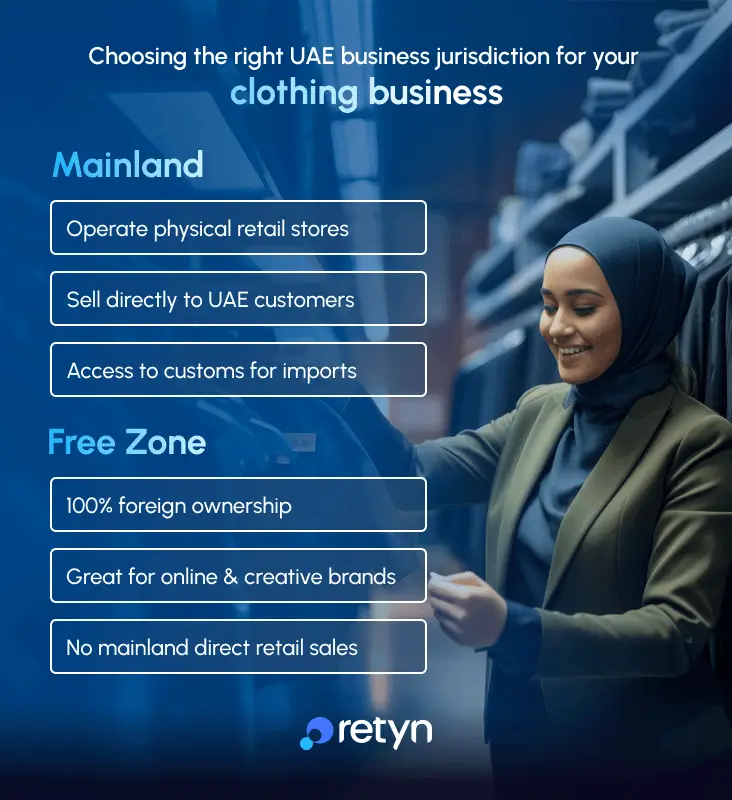
Mainland
Mandatory if you want to open a physical boutique (e.g., in Dubai Mall, City Walk, or a street-side shop) and sell directly to walk-in customers. Choosing mainland company formation in Dubai is a strategic decision that grants your boutique the ability to provide on-site services and home-delivery options across the city.
Key requirements:
Physical Shop / Showroom
Must have a valid Ejari (lease contract) for a retail space.
Dubai Municipality Permit
Approval for shop signage and interior layout (decor).
Dubai Customs Code
Required to import stock (clothes/fabric) from abroad.
Free zones (d3 & others)
Ideal for fashion designers, creative studios, or 100% online brands who do not need a physical shop for walk-in customers. A free zone company formation in Dubai is often favored by international entrepreneurs for its streamlined licensing processes.
Top Choices:
Dubai Design District (d3)
The creative hub. Best for designers, studios, and luxury showrooms.
IFZA / DAFZA
Cost-effective for e-commerce fashion brands and general trading.
Flexi-desk or Studio
Lower overheads compared to mall retail spaces.
Quick Fact
The UAE fashion market is projected to reach USD 1.83 Billion by 2033, exhibiting a growth rate (CAGR) of 3.74% during 2025-2033.
Source: IMARC Group
Step 6: Register & obtain your license
Submit forms, finalize your shop lease, and secure approvals from DET and relevant authorities.
Mainland Application
Trading vs Professional
Choose "Garments Trading" (Commercial) or "Fashion Designing" (Professional).
Ejari (Lease)
You must sign a rental agreement for your shop before the final license is issued.
External Approvals
Dubai Municipality (for shop layout) and Civil Defense (for fire safety).
Free zone Application
Digital Portal (d3, IFZA)
Upload passport copies and photos; typically 100% remote process.
Share Capital
Some zones require proof of capital, others (like IFZA/Meydan) do not.
Customs Code
Required if you are importing fabrics/clothes to a free zone warehouse.
Licence-application document checklist
Mainland Boutique / Store
Passport & UAE entry stamp (all partners)
Emirates ID (if resident)
Ejari Certificate (Shop Lease)
Dubai Municipality Fit-out permit (for decor)
Trade Name Reservation Certificate
No-objection certificate (if on existing visa)
Initial Approval Certificate
Free Zone (Design/E-com)
Passport copy (Color)
Visa / entry stamp or last visit date
Passport-size Photo (White background)
Business Plan (Required for d3)
Lease Agreement (Flexi-desk or Studio)
3 Options for Trade Name
Proof of address (for KYC)
Tip: For physical shops, ensure your contractor submits the 2D/3D layout drawings to Dubai Municipality immediately after signing the lease.
sequenceDiagram
participant Founder
participant DED as DED / Free Zone
participant LandDept as Land Dept / Mall
participant DM as Dubai Municipality
participant Customs as Dubai Customs
participant Bank
Founder->>Founder: 1 · Define Niche (Luxury/Kids/Abaya)
Founder->>DED: 2 · Reserve Trade Name & Initial Approval
DED-->>Founder: Initial Approval Issued
Founder->>LandDept: 3 · Sign Shop Lease (Ejari)
Founder->>DM: 4 · Request Shop Fit-out/Decor Permit
DM-->>Founder: Decor Approved
Founder->>DED: 5 · Submit Ejari & Pay License Fees
DED-->>Founder: Trade License Issued
Founder->>Customs: 6 · Register Importer Code (IEC)
Founder->>Bank: 7 · Open Corporate Bank Account
Note over Founder: 8 · Visa Processing & Shop Opening
Obtain your establishment card, register for WPS (Wage Protection System), and sponsor your team. For retail, this typically includes Sales Executives, Store Managers, and Tailors. Working with UAE visa processing services can help streamline approvals and reduce administrative delays.
Pro tip
Mainland visa quotas are often linked to your shop size. Ensure your shop is large enough for your headcount.
Need clarity on setting up a clothing business in Dubai?
A free consultation helps you understand licensing options, retail requirements and compliance steps based on your clothing business model.
In the fashion industry, your brand name and logo are your most valuable assets.
Once your license is issued, register your trademark with the UAE Ministry of Economy to prevent competitors from copying your designs or brand identity.
Trademark Registration
Protects your brand name, logo, and slogan across the UAE.
Intellectual Property (IP)
Copyright unique textile prints or signature dress designs.
Brand Protection
Allows you to file complaints against counterfeiters selling fakes of your brand.
Pro tip
Registering a trademark takes time (4-8 months). Start this process immediately after your trade name reservation to secure your brand early.
Expert insight: 3 strategic shifts for Dubai fashion brands in 2025
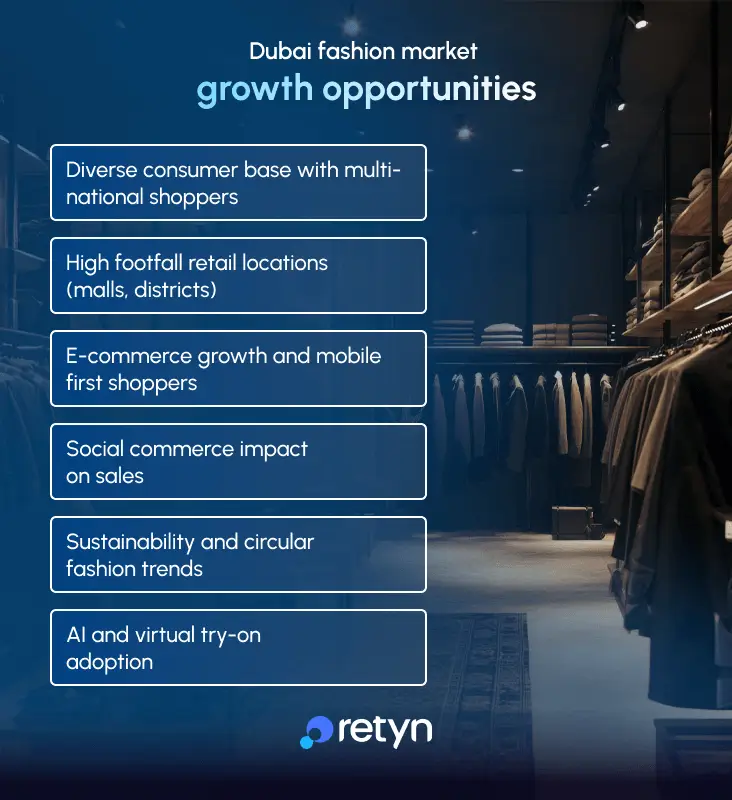
By 2025, the retail space in Dubai will no longer be just a transaction-based “buy and sell” model. It will be influenced by three key factors including AI driven hyper-personalization, the circular luxury economy and the growing social commerce. Clothing entrepreneurs who adopt these trends by reducing return rates through tech, offering sustainable products and using live selling will have the best opportunity to increase customer lifetime value (CLV) and profitability.
Boutique owners can leverage the following three strategic levers to capitalize on these market shifts and remain competitive in high-density retail locations such as City Walk and Dubai Design District.
AI-driven styling and fit tech
Virtual Try-On mirrors and AI sizing plugins can decrease return rates by as much as 30%.
Predictive analytics helps forecast demand for Abaya styles during peak seasons such as Ramadan and Eid as well as how much inventory to hold. This helps avoid overstocking certain designs and understocking of others.
The 'Pre-loved' and circular revolution
Luxury brands are now offering 'Buy-Back' or 'Resell' options in an effort to meet increasing consumer demand for sustainability and circularity within the industry.
An increase in Dubai's consciousness towards environmentally friendly activities have also increased the need to source eco-friendly textiles such as certified organic or recycled materials. This means brands can charge their sustainable luxury products at a premium price to conscious consumers.
Live shopping and social commerce
The “Shop-the-look” integration on Instagram and TikTok has now become the part and parcel of fashion brands. Brands that host live shopping events from their Dubai boutiques on a weekly basis often experience engagement levels up to three times higher than standard online retail interactions.
Use the "Click-and-Collect" model to drive customers from your social channels to your physical store for additional upsell opportunities.
Pro tip
Include a "Sustainability Roadmap" in your business plan when applying for bank loans. UAE financial institutions are increasingly incentivized to fund Green Finance projects, offering better terms for eco-conscious brands.
Decision snapshot – what to choose, at a glance
Structure / Licence
Physical Shop Allowed?
Direct Sales to Consumers
Setup Speed
Best For
Office Rule
Mainland LLC (Retail)
Yes (Mandatory)
✓ (Walk-in)
≈ 3 weeks
Boutiques / Stores
Physical Shop (Ejari)
Free Zone (Design District - d3)
Yes (Showroom)
✓ (B2B / B2C)
1-2 weeks
Designers / Studios
Studio / Flexi-desk
Free Zone (IFZA/Meydan)
No
Online Only
3-5 days
E-commerce Brands
Virtual / Flexi-desk
DED E-Trader License
No
Social Media
Instant
Home-based Solopreneurs
Home Address
* "E-Trader" is limited to GCC nationals and expats (for professional services). Expats trading goods usually require a Free Zone or LLC license.
Risk & penalty matrix – key non-compliance fines
Offence
Fine (AED)
Consequence
Selling Counterfeit Goods (Fake Brands)
100,000 - 1 million
Shop closure & potential deportation
Distributing or posting advertising materials without a permit
1,000
Immediate stop of promotion
Operating media activities without a licence
10,000
Warning from NMC
Figures are based on Consumer Protection & DED schedules. Always check latest circulars.
Signing a shop lease before getting initial approval (if the name is rejected, the lease is useless).
Underestimating fit-out costs—decor approval from the Municipality can be strict and costly.
Ignoring refund/exchange policies—by law, you must display your return policy clearly at the cashier.
Opening a bank account late—you need it to set up POS machines for card payments.
Using a Free Zone license to sell in a mainland mall without a "No Objection Certificate" (NOC) or branch.
Regulation & News updates · Q4 2025
New Consumer Protection Rules – Jan 2025:
Retailers must provide digital receipts and allow exchanges for defective items within 14 days without question.
Influencer Licensing Update:
Brands paying influencers for ads must ensure the influencer holds a valid NMC license to avoid joint liability fines.
Corporate Tax on Retail:
Small businesses with revenue under AED 3m may qualify for "Small Business Relief," exempting them from the 9% tax (Subject to FTA approval).
Dubai Fashion Week 2025:
Registration open for emerging designers to showcase at d3; a great opportunity for new license holders.
Glossary of acronyms
MOQ - Minimum Order Quantity
IEC - Importer / Exporter Code
POS - Point of Sale (Card Terminal)
SKU - Stock Keeping Unit (Product ID)
NOC - No Objection Certificate
VAT - Value Added Tax (5%)
DED - Dept of Economy & Tourism
FAQs on starting a clothing business in Dubai
No. Selling products on social media platforms in Dubai without an appropriate licence is not permitted and can result in heavy fines and other regulatory action. Home-based startups should apply for a DET E-trader licence for small-scale trading, which is the legal solution for GCC nationals and expats (conditions apply). For larger operations, a standard e-commerce licence is recommended.
The licencing fees for a physical and online store are very similar, ranging between AED 12,000 and AED 15,000. However, there are major differences in terms of operational costs.
Physical Boutique: Requires at least AED 40k for rent and approximately AED 15k to 30k for Municipality-approved fit-outs (decors).
Online Store: Does not require rental or decor fees, however you will have to pay for website development, digital marketing and stock photography.
No. The UAE permits 100% foreign ownership for Readymade Garment Trading and Fashion Design licences on both mainland and free zones. As such, you will be able to maintain complete control of your business.
Yes, you can, but you need to obtain a specific activity code. "Readymade Garment Trading" means you are restricted to buying and selling only. If you want to make garments yourself, you need to apply for a "Tailoring & Embroidery Requisites Manufacturing" licence and a workshop must also pass the Civil Defence safety inspections to be acceptable.
No. Free zone companies cannot directly sell to the mainland retail stores or malls in Dubai using a standard free zone licence. To legally trade on the mainland market, you will need to use one of the following structures:
A mainland branch licence with mainland premises
A mainland branch operated from a free zone headquarters (subject to approvals)
A temporary permit for specific projects or events
For mainland UAE clearance, Dubai Customs charges a customs duty of 5%, based on the CIF Value (Cost, Insurance, and Freight), for all fabrics and garments that have been imported.
Businesses wishing to clear goods must first register with Dubai Customs and hold a Customs Client Code, before being able to import cleared items. Imported goods into free zones will not incur customs duty until they have been moved to the mainland and the goods are then subject to customs duty at that time.
To accept payment via Tabby, Visa, etc., on your site first, you must open a Corporate Bank account. Once it is activated, you can add payment gateway services such as Stripe, Telr or Checkout.com. To add BNPL (Buy Now, Pay Later) options from companies such as Tabby or Tamara, you need to submit your trade licence and 3-6 months of bank statements.
Disclaimer: This content is for information only and not legal advice. Regulations change—always consult a qualified professional.
Ready to launch your fashion brand?
Book a free consultation with our retail setup experts for step-by-step guidance.